Hobart Commercial Property Investment
Hobart and the broader Tasmanian commercial market sit at the small end of the Australian capital-city spectrum, with capital values and buyer-pool depth that reflect a population of just over half a million. For yield-led private investors, that scale delivers commercial yields consistently among the widest in the country on comparable covenant. The trade-off is liquidity at exit and a narrower asset-class mix than the mainland capitals.
The tourism economy, the federal government tenant base, and the maritime industry all sit on top of a smaller commercial stock than any other capital. Read the city on its own terms.
Hobart is a small market with character, not a discounted mainland capital. Size the brief for the city, not against it.
The Hobart Submarkets
Hobart CBD
Office stock runs along Macquarie, Elizabeth, and Murray streets. A grade office is limited; B and C grade dominate. State government tenants, the University of Tasmania, and federal agencies anchor a substantial proportion of leasing demand.
Waterfront and Salamanca
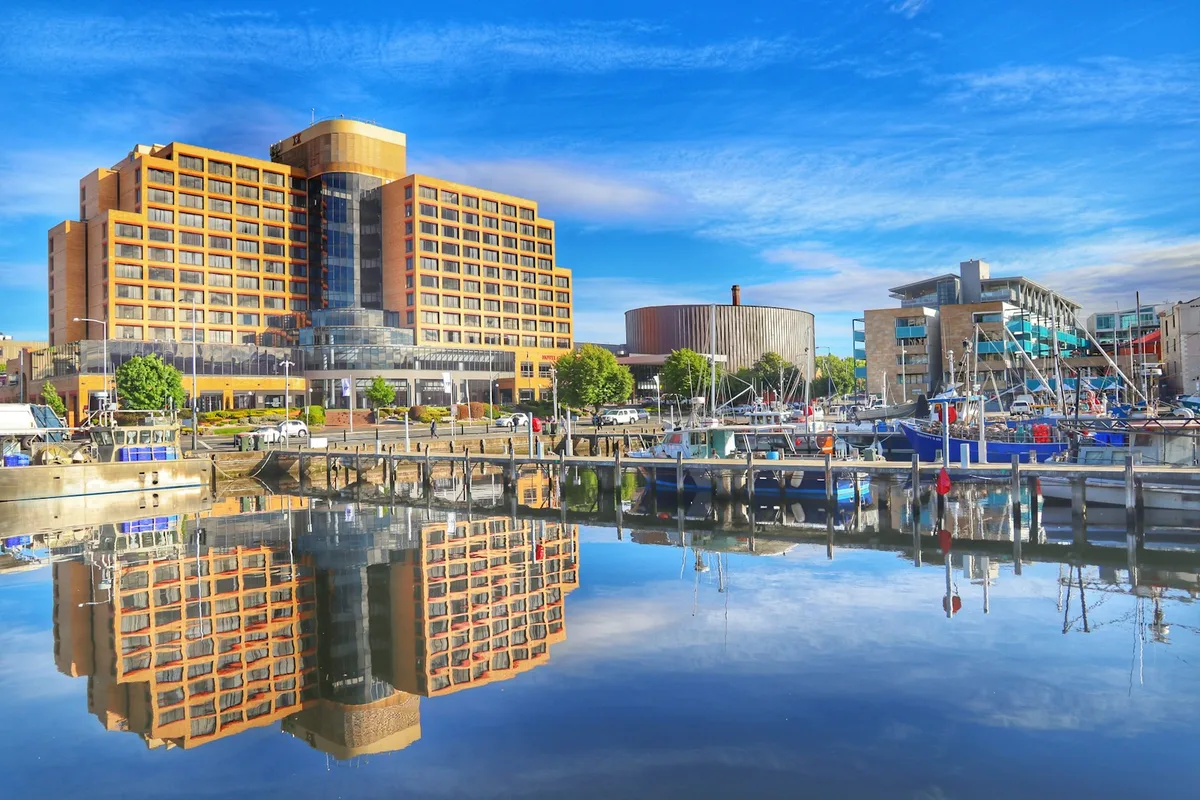
Boutique retail, F&B, and mixed-use line Sullivans Cove and Salamanca Place. Income is tourism-led, with strong domestic and international visitor appeal, and a heritage overlay covers most of the precinct.
Sandy Bay, North Hobart, Battery Point
Small-format retail and mixed-use commercial. Owner-occupiers compete hard for sub-$2 million stock; investor-grade stock is thin but premium.
Glenorchy and northern suburbs
Suburban office, neighbourhood retail, and light industrial. Entry prices sit below the CBD, with wider yields and longer-dated holds.
Launceston
The state's second city has a small but distinct commercial market. The CBD around Brisbane and Charles streets supports office, retail, and mixed-use. The northern industrial pocket carries trade and warehousing.
1 Why Hobart Yields Are Wider
Two structural forces keep them there. First, the buyer pool is shallow: local institutional and family-office capital is thinner than the mainland capitals, and national investors compete only for the larger stock, which leaves the sub-$5 million market to local private investors. Second, the market itself is small, so on a limited total stock of investment-grade commercial the buyer pool's preferred asset-class concentration sets the marginal price.
The yield premium is real and largely structural. It does not necessarily compress as quickly as in tight-yield mainland markets, because the structural drivers do not change with macro conditions.
2 The Tourism Economy
Tasmania has built a deep tourism industry over the past 15 years, anchored by MONA, the food and wine economy, and the natural environment. Tourism-linked commercial, meaning Salamanca retail, waterfront F&B, and accommodation freeholds, trades on a separate set of drivers from the rest of the commercial market.
For a tourism-linked asset, the buyer-side review covers:
- Multi-year tourist arrival data (international and domestic).
- The tenant's seasonal revenue pattern.
- The operator's rent coverage at the low-season trough.
- Lease structure (turnover rent, percentage rent, fixed base).
3 The Government Tenant Base
Hobart carries a higher government tenancy concentration than the Sydney or Melbourne CBDs. The Tasmanian state government, the federal government, and the University of Tasmania anchor much of the office leasing market. The lease characteristics resemble Canberra: shorter committed terms, break clauses, and restrictive disclosure.
4 Tasmania-Specific Buyer-Side Considerations
Stamp duty
Tasmanian transfer duty applies on the general schedule for commercial property. Tasmania also has a Foreign Investor Surcharge that applies to relevant buyers. There is no first-home or off-the-plan relief for commercial buyers.
Land tax
Tasmanian land tax applies above the general threshold on the unimproved value of taxable land held by an owner. Holdings aggregate across multiple properties within Tasmania, and the rates are progressive.
Heritage overlays
Hobart and Launceston carry extensive heritage overlay coverage, particularly across the waterfront, CBD, and inner-suburb precincts. Heritage controls can affect both the alternative-use value of an asset and the cost of capital works during the hold period.
5 How We Run a Hobart Brief
Budget eight to fourteen weeks for a well-defined Hobart commercial brief. The local agency network is concentrated: a few national firms with Hobart offices plus three or four boutique brokers. Inspection logistics from Sydney or Melbourne require day-trip planning, and we coordinate on-the-ground inspection support.
Frequently Asked Questions
Is Hobart commercial property liquid at exit?
For institutional-grade assets (long-WALE national-covenant, CBD A grade), the buyer pool is national and exit liquidity is similar to other capitals. For sub-$5 million local-market commercial, the buyer pool is principally Tasmanian and exit liquidity is thinner.
Can I run a yield-only brief in Tasmania?
Yes. Tasmania is among the easiest markets to brief for high-yield commercial. The discipline is separating structural yield premium, which is real and persistent, from cyclical yield premium, which compresses in better markets.
Does the tourism economy affect non-tourism commercial?
Indirectly, via the broader Tasmanian economy. Industrial, suburban office, and government-tenant office demand tracks the permanent population and state economic activity more closely than tourism.
Do you cover Launceston and the regional north?
Yes, on the understanding that the buyer pool is even thinner than Hobart. We scope Launceston briefs accordingly.